
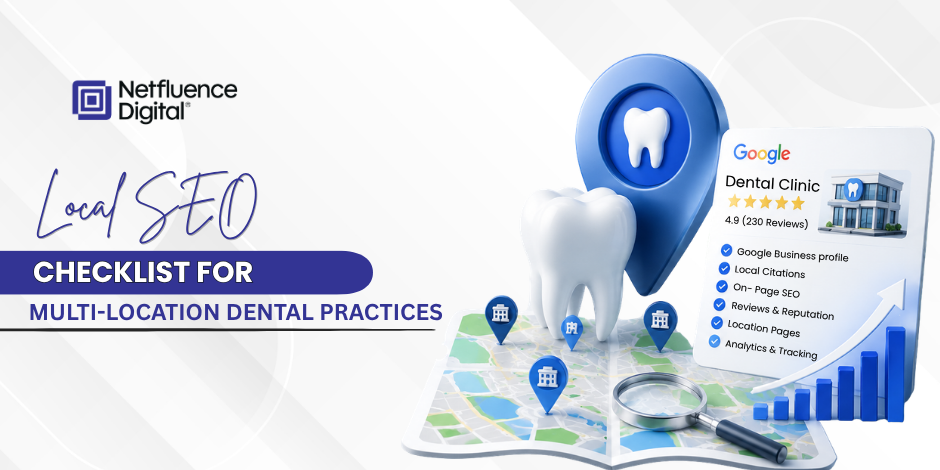
Running local SEO for a single dental clinic is a well-understood process. Running it properly across 5, 20, or 100+ locations for a Dental Service Organization (DSO) or multi-location group is an entirely different operational challenge, and it’s where most in-house marketing teams start to break down. This checklist reflects the process that any experienced dental marketing company in India should follow for multi-location clients across the US, Canada, and Australia.
Every physical location needs its own, fully independent Google Business Profile. Never a single shared profile listing multiple addresses, which confuses Google’s algorithm and typically results in poor ranking for every location involved.
Checklist per location:
A common and costly mistake among multi-location dental groups is a single “Our Locations” page listing addresses instead of a dedicated, uniquely written page for each location. Each location page should include:
For a single clinic, NAP consistency is a manageable manual check. Across dozens of locations, it requires a systematic, spreadsheet-driven (or dedicated software-driven) audit process covering the following:
Even a handful of inconsistent listings across dozens of locations can meaningfully dilute overall local SEO authority, which is why this audit needs to be built as a recurring process, not a one-time cleanup.
The most effective structure for multi-location dental SEO separates strategy (which stays centralized: brand standards, overall keyword strategy, and reporting structure) from execution (which needs to happen at the individual location level: citation building specific to that city, review generation specific to that office, and content localized to that community).
This split is precisely why so many US, Canadian, and Australian agencies managing DSO and multi-location dental accounts choose to outsource dental marketing to India for the execution layer: a dedicated team can manage the repetitive, location-by-location work (citation submissions, review monitoring, GBP post scheduling) at a scale and cost structure that’s difficult to replicate with an in-house team handling every location individually.
A single blended report across all locations often hides which specific offices are underperforming. Effective multi-location reporting breaks out, per location:
This location-level visibility allows a marketing team (in-house or outsourced) to quickly identify and fix underperforming locations, rather than having them masked by strong performance elsewhere in the network.
Phase 1 (Weeks 1-4): Full audit of existing locations: NAP consistency, GBP completeness, page architecture gaps.
Phase 2 (Weeks 5-12): Build missing location pages, correct NAP inconsistencies, and launch or standardize review generation systems location by location.
Phase 3 (Ongoing): Citation building, content localization, monthly per-location reporting, and continuous review/reputation monitoring across the full network.
Multi-location dental SEO isn’t single-location SEO repeated many times; it’s a distinct operational discipline requiring centralized strategy and standards, paired with genuinely localized execution at every individual office.
Groups that treat every location as a fully independent SEO entity, supported by consistent processes, consistently outperform those that apply a uniform approach across their network.
Netfluence Digital manages local SEO at scale for multi-location dental groups and DSOs across the US, Canada, and Australia, working as a white-label dental SEO marketing company in India for partner agencies.